
Exhibitions

Shop It!
The desire for objects, the passion for "shopping," is translated today into a popular pastime. Indeed, a large part of happy humanity solemnly attends the rituals of consumption, equipped with credit cards. Its goal is to find meaning and discover a new identity: "I consume, therefore I am"; I am inseparable from a large group of happy beings – consumers of merchandise and opportunities.
Sunday, 17.02.19
Lost in Translation
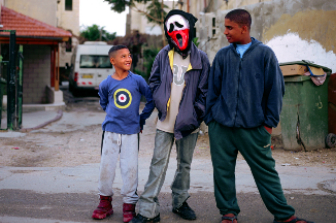
The works in this show seek to indicate a hollow, consumer-oriented trans-cultural world created by the unchallenged dominance of globalization. These works examine the multiple meanings involved in the import of commodities, customs, cultures, and people, and the aggression involved in its implantation, as a reflection of contemporary cultural imperialism.
Sunday, 17.02.19
Not Your Toy
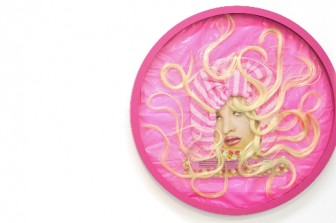
The critical-ironic gaze appearing often in the exhibited works emphasizes the carnivorousness aspects of feminine shopping.The act of shopping itself is depicted as some sort of a subversive practice. The exhibition manifests the ways in which artists, particularly young female artists, use excess and radicalization as the means of artistic creation
Sunday, 17.02.19
Shopping Mall
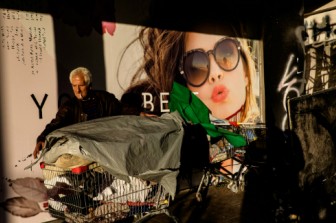
Their works seek to comprehend the "mall" idea as it appears in the contemporary artistic discourse, with reference to the cultural assumptions and power relations it embodies.
Sunday, 17.02.19
Trash Culture
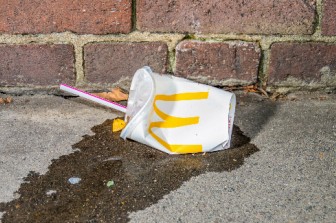
The variety of works presented seeks to emphasize that trash is one of the central elements in contemporary culture, both in daily life and in a subversive, theoretical context. The term "trash culture" denotes the view of trash as a necessary side effect of a capitalist society intent on the increased production of food, of commodities, and of ideas. As production soars, so does trash. In contemporary art, then, "trash" has become an idiom defining a cultural condition and shaping some of the channels of discourse pursued in the culture.
Sunday, 17.02.19
Money with a Capital "M"
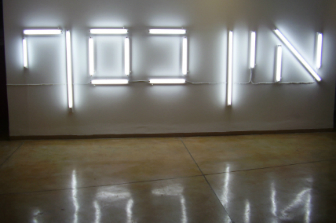
The works in the show reflect a conceptual connection between glitter and seduction, superficiality and fragility, while also representing the "want of matter" in Israeli art. Familiar classical motifs are presented as victims of Western consumer culture, which turns every cultural element – even sacred icons – into an object manufactured on a uniform production line. The different means of representation reflect a critical engagement with the world of obsessive consumption that has swept up Israeli society in general, and the field of art in particular.
Sunday, 17.02.19
Eyal Assulin: Majesty
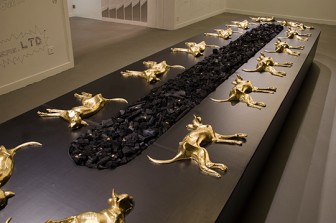
Eyal Assulin's visual language explores the culture of prosperity with reference to global socio-economic aspects. His works engage with Eastern culture, featuring a matrix of historical, gender, and artistic status symbols. These are presented in a forthright manner that parodies the bulimic impulse of contemporary consumerism.
Sunday, 17.02.19
Hannan Abu-Hussein: Body Fragments
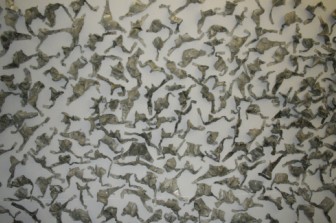
Hannan Abu-Hussein's installation consists of used brassieres fixed in cast concrete. This technique is characteristic of her works, which often use unconventional raw materials. The artist employs these materials in order to express her personal-feminist voice on the issues of religion, capitalism, sexual exploitation, love, and personal freedom.
Sunday, 17.02.19
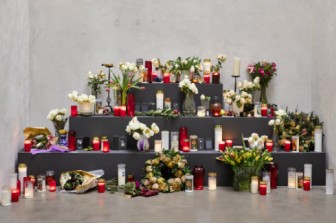
Addie Wagenknecht - Shrine for iPhones, 2018
In her works, Addie Wagenknecht addresses the ethos of the hacker culture and the dark side of the data systems that construct contemporary reality. In the installation Shrine for iPhones (2018) the artist creates a kind of monument to outdated mobile phones that are discarded after each technological update.
Sunday, 17.02.19
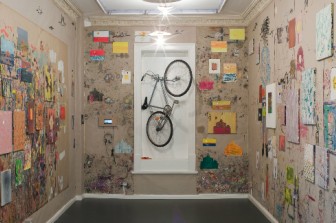
Olaf Kuhnemann: Bicycle Temple
The bicycles around which this installation is built are associated with the inspiration Olaf Kuhnemann draws from the streets of Berlin – the city he is residing in recent years. As the seasons change, with winter's depression replaced by the mania of spring and summer, the city's boulevards fill with bicycles.
Sunday, 17.02.19
Please contact us and we will contact you as soon as possible