
Exhibitions

Saturday, 20.06.09
Saturday, 20.06.09
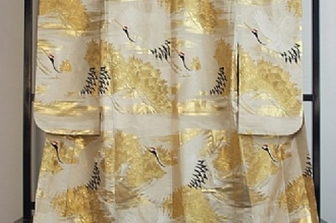
Kimono
In its broadest sense, the Japanese word "kimono" means "clothing", and it is usually applied to the traditional and specific garment which is the national dress of Japan, shaped like a T, with rectangular sleeves, which is wrapped around the body.
Monday, 11.05.09
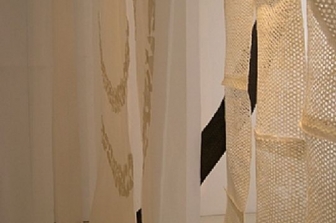
The Gateless Gate
The contemporary artist Kumagai Masa creates installations out of handmade Japanese paper.
Saturday, 10.10.09
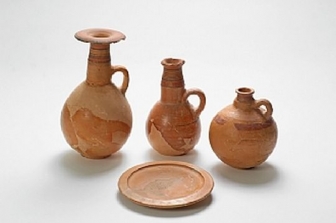
Shikmona and its Treasures
Tel Shikmona, extending over eight dunams, has revealed some very rich archaeological finds, shedding light on the settlement's ongoing existence from the Late Canaanite era (15th century BCE) up to the Early Muslim era (7th century CE).
Sunday, 09.06.24
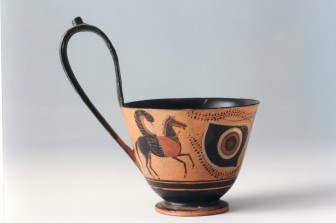
Decorated Pottery from Greece and Southern Italy
The current exhibition presents vessels decorated in the Black-Figure style (7th-6th centuries BCE) and Red-Figure style (6th-4th centuries BCE). The latter was also prevalent in southern Italy and in Sicily, having reached there with migrants from Greece. Characteristic of these vessels are the wonderful decorations derived both from mythology and from daily life
Sunday, 09.06.24
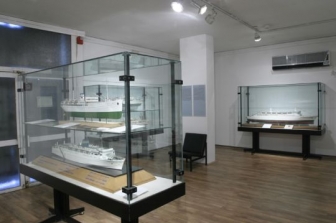
Hebrew Shipping in the 20th century
In his allegorical work "Altneuland", Theodore Herzl envisioned Haifa as a city with a large, busy port from which ships bearing an emblem of seven stars set out for all parts of the world. His suggestion for the national flag, which was not accepted by the national establishments, was adopted by the national maritime company when it was formed.
Sunday, 09.06.24
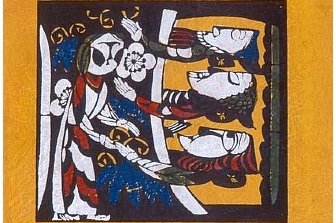
Great Japanese Print Artists of the 20th Century
When the gates of Japan were opened to the Western world at the time of the Meiji Restoration in 1868, a new era of modernization and industrialization began, bringing with it many political, economic, and cultural changes.
Sunday, 01.11.09

Saturday, 09.01.10